Replacement Windows Pros
913-439-3683
Picture Window Replacement in Leavenworth, KS
A picture window is one of the simplest windows we install: one big fixed pane of glass, no moving parts. That sounds like a limitation until you understand what you get in return. More glass, more light, better insulation, and a lower price than most operating windows. If there's a view worth framing or a dark room worth fixing, this is the window that does it.
Most of the time we're swapping your old picture window for a new, better-insulated version that also knocks down outside noise. But sometimes there's a bigger opportunity. If you've got two windows close together, we can combine them into one large picture window. It brightens up a dark living room and changes the whole feel of the house, inside and out.
What is a picture window?
A picture window is a single fixed pane of glass that doesn't open. No sashes,
no crank, no moving parts.
The classic spot is the living room, especially on homes with a view worth looking at. West-facing rooms that catch Kansas sunsets. Front rooms on the older two-stories. Stairwell landings and dining rooms where nobody was ever going to open the window anyway.
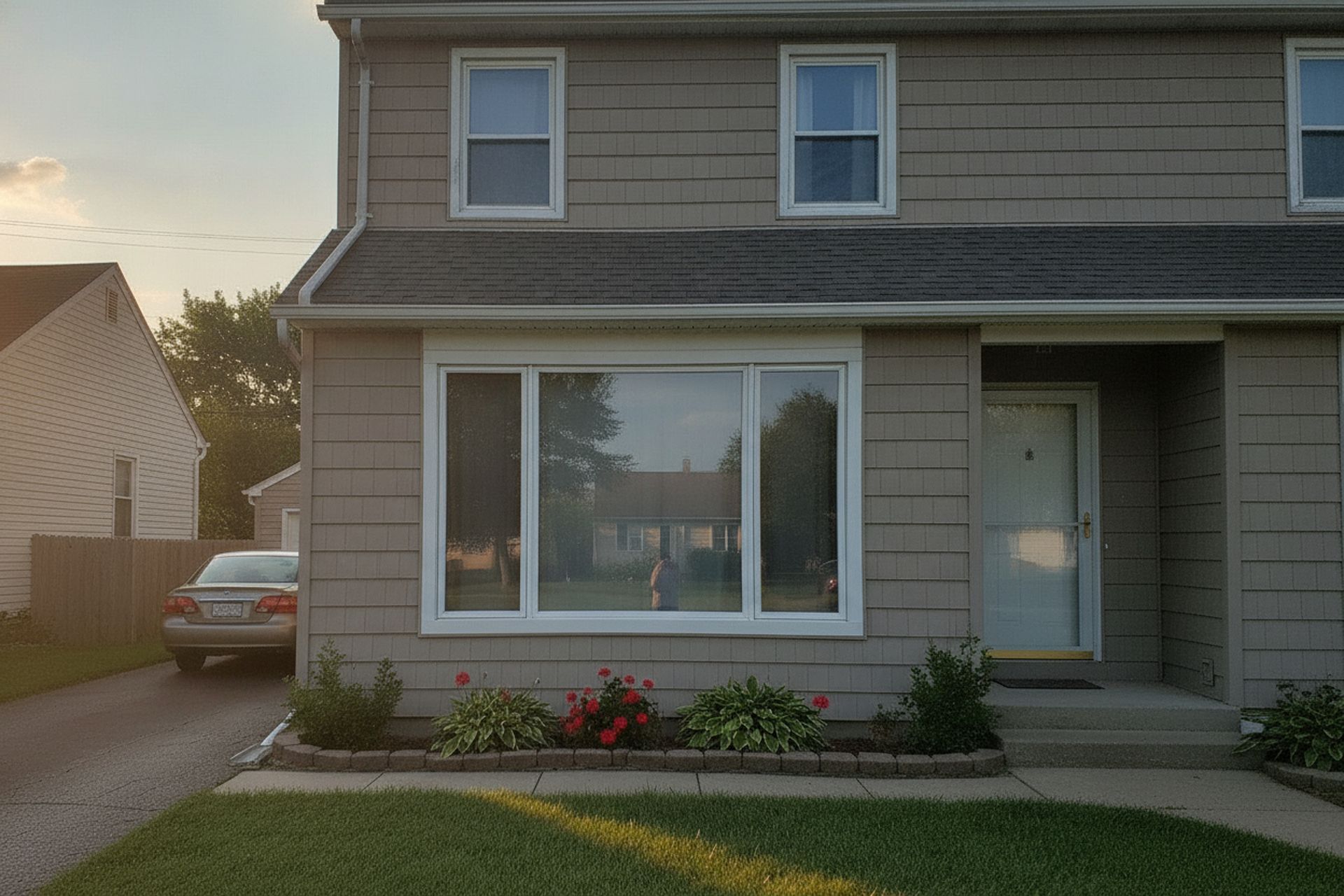
The biggest issue: no ventilation. That's why large picture windows are often paired with operating windows on either side. You get the big glass in the middle and airflow on the sides. It's a very common configuration we install, and it usually costs less than three same-sized operating windows would.
The payoff is a window that performs like it did when the house was new: better insulation around the frame, and no drafts sneaking through gaps the old frame left behind. On rotting drafty windows, or in older Leavenworth homes it's often the option that actually solves the problem instead of hiding it.
Why picture windows insulate better
No moving parts means no seams for air to sneak through. A fixed pane sealed into its frame is simply tighter than any window that opens, no matter how well the opener is built. Add double or triple-pane glass with Low-E coating and a picture window becomes the best-insulating opening in your wall. If you're replacing a drafty old bay of single-pane glass, the difference in that room next January will be obvious.
A straight answer before you buy
Not every room is a picture window room. Bedrooms need windows that open, and code requires it for egress. Kitchens want ventilation. We'll tell you where a picture window works in your house and where it doesn't, because a window you regret is a callback we don't want. Click here to Call or text, or request your free quote.
Can you combine two windows into one big picture window?
If your living room has two windows sitting a few feet apart, there's a good chance we can take out both, open up the wall between them, and install one large picture window in their place. It's the single biggest transformation we do. A room that always felt a little dim suddenly has a wall of glass, and the outside of the house looks intentional instead of builder-grade.
It's more involved than a standard replacement. We're modifying the framing and installing a new header to carry the load, then patching the siding and drywall so it looks like the house was built this way. That means it costs more and takes longer than a swap-out, usually a day or two instead of a few hours. Not every wall can take it, and we'll tell you straight if yours can't. Load-bearing walls need proper engineering, and we don't cut corners on structure.
If you've been staring at two skinny windows thinking the room deserves better, send us a photo of the wall. We'll tell you whether it's a candidate and roughly what it'd run.
Whether it's swapping an old drafty picture window for one that actually insulates, combining two skinny windows into one wall of glass, or finally fixing the dark room you've learned to live with, the first step is the same: figure out what you want, and what you can do about it. That's the part most companies skip. They quote you a window without ever asking what you're trying to change about the room.
Not sure if a picture window is right for your space? That's a great question, and the answer depends on the room. Text us a photo of the wall and we'll tell you, whether it's a straight swap, a candidate for combining windows, or a spot where you're better off with a window that opens.
Call or text 913-439-3683 —to request your free quote.

Contact Us
Signs Your Picture Window Needs Replacing
A picture window has no moving parts, so when one starts failing it shows up in
the glass or around the edges. The clearest sign is fog or haze trapped between
the panes that won't wipe off from either side, which means the seal is gone.
After that: a draft you can feel along the frame on a windy day, water stains or
soft wood at the sill, and a crack or chip that keeps spreading. Any one of those
is worth a look.
Repair or Replace: Glass Only, or the Whole Window
Because a picture window doesn't open, you sometimes have an option a double-hung
doesn't give you. If the frame is square and sound and only the glass seal has
failed, the insulated glass unit can often be replaced on its own while the frame
stays put. That runs a fraction of a new window. Replacing the whole unit is the
right call when the frame is rotted, out of square, or the opening itself is
changing size.
What Picture Window Replacement Involves
Picture window replacement starts with measuring the opening, because large fixed windows are built to order rather than pulled off a shelf. We take out the old unit, set the new one level and square, insulate the perimeter, flash it so water sheds away from the opening, and seal it inside and out. A straight swap is usually a few hours. If the opening is being enlarged, plan on a day or two.
What Affects the Cost of a Picture Window
Size drives the price more than anything else, because glass cost climbs fast as the pane grows and big units take more hands to set safely. The glass package matters too: double or triple pane, Low-E coating, and whether code requires tempered glass. Large windows set low in a wall usually do. The 2018 IRC calls for safety glazing when a pane is over 9 square feet, sits less than 18 inches off the floor, rises more than 36 inches, and has a walking surface within 36
inches of it. Access and any wall modification round out the number.